As I write the words “Year in Review”, my mood is roughly one of “alone in desolation, tears falling unbidden”. A year-end summary that was mostly finished long ago very nearly ended up abandoned because of a mycoplasma infection and exam pressure, so being able to finish this review at all has been no easy feat.
2023 was a difficult year: difficult to endure the wave of infections at the start of the year, difficult to return to campus and sit the postponed final exams from the previous term, difficult to complete course projects, difficult to adjust my mental and emotional state, difficult to watch the world continue to deteriorate… I struggled through my own life, and what kept me going through the year was probably nothing more than the basic human instinct to survive.
I don’t know how your year has been, but if you’re still alive, that’s enough.
Studies
Life played a very cruel joke on me.
Ever since I entered university, my studies have never gone especially smoothly, and this year was no exception.
After a winter break longer than the summer holiday, I discovered that the final exams for five major modules, postponed because of the chaos caused by the abrupt shift in COVID policy last term, were now bearing down on us all at once. Perhaps thanks to some kind of self-protection mechanism, my mind had not yet completely fallen apart. My roommate, by contrast, was already on the verge of a breakdown, which says enough about how crushing that explosion of exam scheduling pressure was. But because of that same protection mechanism, I could only revise under immense mental strain and at very low efficiency, and the final outcome was predictably grim. In the second semester of my second year, I adjusted my state, rested, and recovered my energy. In plain terms: I stopped going to lectures. But that did not mean I stopped studying; at the very least, my exam results were much better than in the previous disastrous term. Even so, something unexpected happened: I failed Embedded Systems, which was frankly absurd. After asking around, I found out it was because I missed the 8 a.m. roll call and lost marks for attendance. Then I got 80 in the resit, while another resit student I had helped got 100 by memorising stock answers by rote. Highly ironic.
In the first semester of my third year, after a summer holiday, I became deeply convinced that I needed to study “hard”. Looking back now, this was not a good thing. Because of that idea, and because my dorm was too noisy with people gaming, I ended up going to the library almost every night. I seemed to push myself too “hard”, to the point that an old psychological wound flared up again; saying the pain was seared into me is no exaggeration. For several days I cried uncontrollably in the library, then went back to the dorm and forced a smile. That inner torment, combined with excessive “hard work”, drained me completely, and I simply could not keep studying. I now finally understand that, given my mental state, studying in the library was the wrong decision.
Looking back, the way I handled it was almost exactly like my immature self in the second semester of first year, when I tried to restore my old sixth-form study habits. Running off to the library every evening was genuinely painful and terribly inefficient. Going in circles only to end up back at the starting point is not a good feeling, and yet at the time it really did seem like the best choice I could make. Still, I should not have repeated the same mistake.
I suppose I’ve realised that my mind simply does not allow me to study too intensely. Once I go past a certain threshold, some protective mechanism kicks in, numbs my nerves, and refuses to let me push any further. At present I do not know whether I can break through that limit, but if it reminds me to rest, perhaps that is not entirely a bad thing. Still, when I want to give studying everything I have, and this limit appears instead, is that not a kind of sadness in itself? I feel like the unluckiest university student in the world: right before finals, I came down with mycoplasma pneumonia, and yet the utterly deranged timetable still forced me to revise as if I had only missed two days of class. In the end, I worked hard and got nothing. Since starting university, I’ve failed quite a few modules by now. I have never felt so deeply the despair of “no matter how hard I try, my grades just won’t improve”. Perhaps this is punishment for some foolish wish I once made. And when I think about all the suffering I have endured over the years, in the final analysis, perhaps this is simply the punishment for being lower-class, for being poor. Why should I have to pay for that? If Heaven exists, can it answer me?
The power grid planning course project I did this term deserves a section of its own. At first we tried to buy one, but in the end it amounted to nothing more than paying tuition fees in another form, which was rather ironic. I strongly suspect one of the people involved padded it out with ChatGPT. So in the end, we completed in one week what would normally take others a month, and in order to submit it before the deadline, everyone in our dorm stayed up until half past five doing the final copying by hand. More than forty pages of coursework report, all handwritten — quite an experience.
Health
Compared with last year, my health did not change much. At most, I recovered from COVID at the beginning of the year, then got hit with a mycoplasma infection at the end. And I was also diagnosed at a neurological hospital with moderate depression and OCD.
The depression still flares up from time to time, while I personally feel the OCD does not affect me too badly. When the depression hits, apart from drinking a bit more and resting more, I really have no other way of dealing with it. The mental health crisis is still ongoing, and this year the return of an old inner wound drained all my energy for a while.
Falling into some inexplicable state:
Can’t enjoy entertainment, don’t even want to listen to music
Can’t study, while exams keep coming one after another
Can’t rest properly, can’t even sleep well
In other words: I can’t enjoy myself, can’t study, and can’t even rest
This bout of utter exhaustion finally made me realise just how precious human energy is. I know perfectly well that, in the end, my behaviour amounts to giving up on myself. I need social support, something I have almost never had. COVID and mycoplasma also triggered my anxiety and depression. The extent of how difficult life feels for me now is hard to put into words, but there is nothing I can do except grit my teeth and endure it. I started retching as well, probably because my anxiety symptoms worsened; at any rate, the psychiatrist recommended medication.
Throughout the year I kept trying to treat myself and seek support from the outside world. Strange though it is, life has already tormented me so much, and yet the instinct for survival keeps dragging me onwards. Perhaps that is a blessing for humanity as a whole, but for each individual it also becomes a sorrow.
Books I Read
Books do not change, but people do.
Reading is really a way of reading oneself. In 2023, I read some new books, and some old ones I love very much. Every time I reread those old books, it feels as though I am reading them for the first time.
Whenever I finish a book, I upload the e-book to books.l3zc.com. There may be exceptions, of course, but after sorting through them, the literary works I read this year included:
- Big Breasts and Wide Hips (Mo Yan)
- Lynching (Liang Xiaosheng)
- Random Sketches of a Journey to Xiang (Shen Congwen)
- Autumn in the Old Capital (Collected Works) (Yu Dafu)
- If Cats Disappeared from the World (Genki Kawamura)
- A Lost Paradise (Jun’ichi Watanabe)
- Summer, Fireworks, and My Corpse (Otsuichi)
- The Eastern Capital: A Dream of Splendour (Meng Yuanlao)
- Ten Brocade Satin (Fang Cunguang)
- The Miracles of the Namiya General Store (Keigo Higashino)
- After School (Keigo Higashino)
- I Am a Cat (Natsume Sōseki)
- The Ferryman (whoever wrote it)
Besides these, there were also some web novels and light novels, but I do not intend to list them here.
It is easy to see that of the twelve literary works I can remember from this year, the vast majority came from East Asia. As for The Ferryman, the only Western title among them, I thought after reading it that it was very mediocre — even downright bad. In “Diction and Sentence-Making”, I mentioned that I greatly admire the command of language possessed by Shen Congwen, Yu Dafu, and even Fang Cunguang, the author of the erotic wuxia novel Ten Brocade Satin (his command of Chinese really is excellent). As for translated works, if any one of the original author, the translator, or the publisher falls short, the reading experience suffers badly. But within the East Asian cultural sphere, there is a high degree of cultural similarity, so translations tend to read more naturally and feel more familiar.
Even so, in terms of the kind of stylistic mastery I want, among living translators I still have not seen anyone like Fu Lei, who could so thoroughly fuse two languages while preserving a style of his own1. These translated works still cannot quite compare with native literature, which is why “original” domestic writing still made up nearly half of what I read.
I like Republican-era writing; I like the concision of the transitional period between classical and vernacular Chinese, and that plain, unadorned, almost primal emotional force. People say China has produced masters in only two eras: the Warring States period and the Republican era. That is no exaggeration. The fact that people could write in such an easy, unpretentious tone proves at least two things: the government was not censoring them, and their income was enough to live comfortably. Since 1949, those two conditions have never been met at the same time. What is laughable is that the current authorities still promote the line about “old China” being “poor and weak”. It is shameless in the extreme.
Something I wrote after finishing Autumn in the Old Capital and Random Sketches of a Journey to Xiang
(To be continued)
Places I Went
At the beginning of the year, I went on a long journey, more or less following the Shanghai–Kunming Expressway from Changsha to Lijiang, passing through many cities along the way. On that trip I hiked Tiger Leaping Gorge and spent quite a long time in Lijiang Old Town, which was a genuine chance to relax both body and mind — apart from the ten-hour traffic jam on the way back, of course.
In August I went to Wuhan, mainly to do a bit of anime/game pilgrimage for some Chinese-made visual novels.
Rather embarrassingly, as a student who is not exactly well-off, I simply cannot afford frequent long-distance travel. I would like to see more of the world too, but I have no money, my passport is not especially useful, so I can only give up and go to bed.
Music I Listened To
Music is an important part of my life. Since none of the platforms I use produces an annual report worth looking at2, I decided to make my own year-end playlist summary.
The singers who really made me sit up this year were mainly Camellia and TAYORI (which is to say, Isui). The former is a high-BPM monster, the latter more in the J-pop vein. Stardust3, after her upgrade, genuinely amazed me, so naturally I looped those songs many times, and they left their mark on my year-end playlist.
There is a view that music is anti-social. I rather agree. When friends get together, do they usually sit and listen to music together? Clearly not. And even in the rare cases where they do, what gets played is mostly mainstream music that everyone can accept.
For pop music to become pop music, it always has to make certain compromises. Compared with so-called “hidden gems”, it inevitably lacks a certain uniqueness.
Behind every song on this playlist there is some story, some experience. They may have been my companion while walking around campus in low spirits, background music adding flavour to a game, or a lazy melody helping me pass the time on the commute… Here I find myself unexpectedly at a loss for words. But when I see them, I can still remember the surprise and emotion of hearing them for the first time. To someone who did not live through those moments, though, they might simply sound ordinary.
I do not listen much to current chart music any more. This year, among the music I heard, fewer songs gave me that feeling of surprise. Compared with my manually compiled playlists for 2021 and 2022, choosing tracks for this year felt especially difficult. Is it because the music I heard really has been getting worse? Or because this year brought more pressure than before, leaving too many bad memories attached to it? I think it is probably both.
Games I Played
Let’s start with my Steam Year in Review:
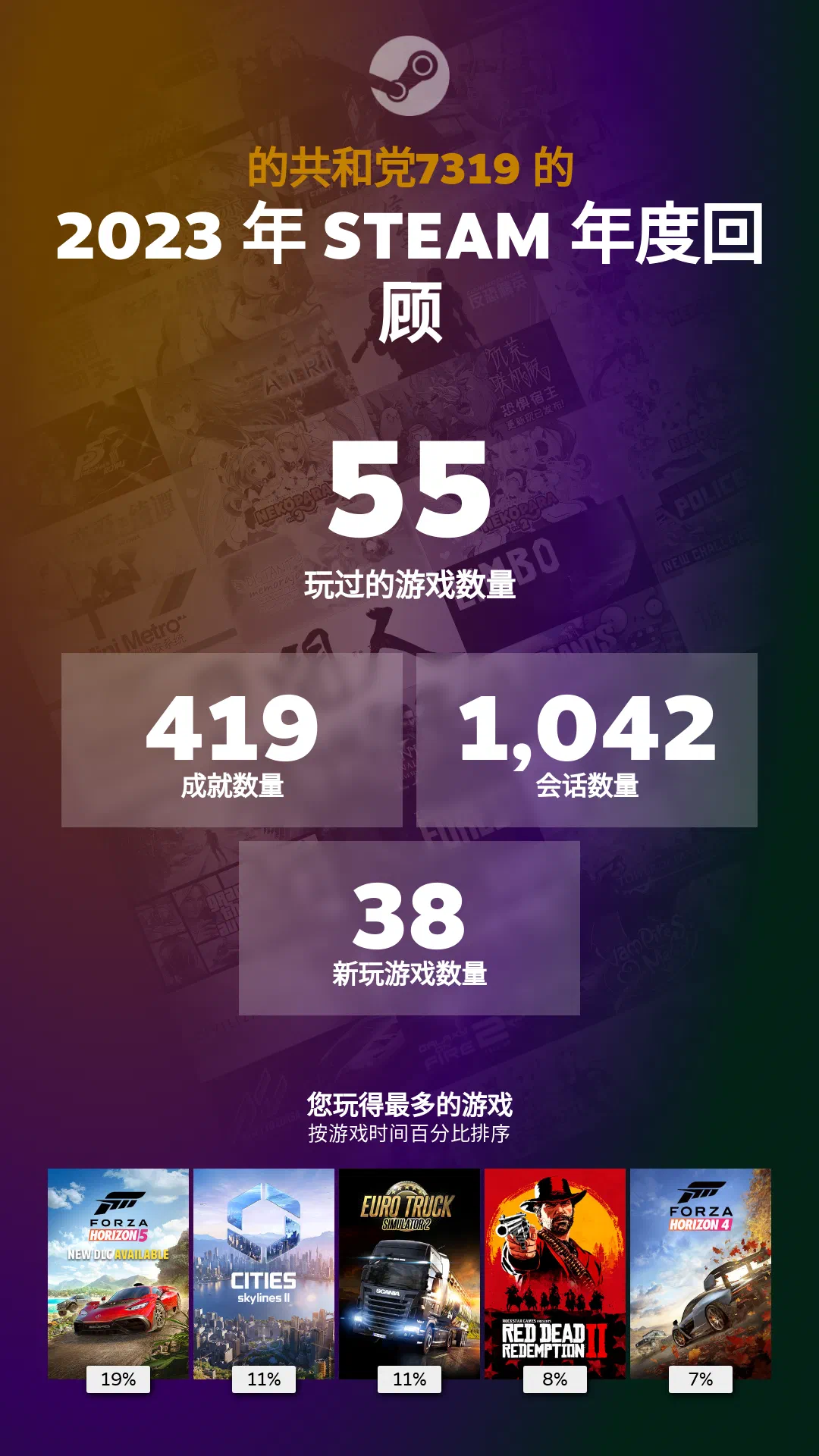
Most of my gaming activity takes place on Steam, so I think this report is quite representative.
In 2023, most of my gaming time went into games related to “cars”: Forza Horizon 4 and 5, and Euro Truck Simulator 2, which together kept me company for 200 hours of playtime. There is a saying that poor people play with cars and rich people play with watches. Well then, as a poor student who cannot even afford to “play with cars”, I suppose all I can do is mess about with games.
As for why I do not play some games on Steam — well, the reasons are complicated. Among those, the one I played most was Stellaris, which I estimate I played for at least 150 hours. Second would be Minecraft, but that game is far too boring without other people, so in reality I probably only played around 30 hours.
It is also worth mentioning the visual novels/Galgames I read this year: roughly 20 in total. There were “classic titles” like Nekopara; Chinese-made Galgames such as Tricolour Lovestory and Love Stories; and some more niche works like The Expression Amrilato and Natsu no Kusari. Some of these were R18 titles, though most were simply visual novels. A visual novel is really a more advanced form of the novel; a good one can completely surpass ordinary novels in both literary quality and storytelling.
After making my way through that whole batch of visual novels and Galgames this year, I was genuinely surprised by the level Chinese-made Galgames are capable of reaching.
Chinese-made Galgames win me over through their sense of familiarity — the familiarity of the subject matter, the familiarity of the living environment — something other Galgames simply cannot provide. As I mentioned earlier, I am glad to see that, even under immense pressure, Chinese Galgames still hold on to their ambitions and bring us excellent works. Strange though it is, even in such a poor environment, we still manage to achieve things in some areas. People are always eager to praise those achievements, taking suffering as somehow justified, yet no one ever asks what created such a poor environment in the first place.
As I said earlier, outstanding works can surpass ordinary novels in literary merit and storytelling. Some of the titles I played even engaged with social issues, and some could even speak up for minority groups. In the creative environment of mainland China, that is extraordinarily rare and precious.
I did not touch Genshin Impact at all this year. Now I’m back to do some main story quests and see what absurd things the planners have been up to.
Social Life
My social life this year felt awful.
This term we changed dorms. One of my original roommates suspended his studies, and a new roommate moved in who was unbearably noisy. That was also an indirect reason I started going to the library — I needed somewhere quiet to think about my own problems.
I may need a few friends, or a cat.
There really is hardly anyone to play games with me, so naturally nobody plays Minecraft with me. There is no one to go virtual driving with either, so I can only play by myself. And I do not play FPS games in the first place.
Every now and then a few of us from the dorm go out to play badminton, and those times do feel rather nice.
Actually, I do rather miss the days when everyone in the dorm played Genshin Impact together. We were all quite happy then. Just as I wrote in my July summary: after years of loneliness, I think I have started to long for in-person social life. I moved house many times growing up, so I never had childhood friends I stayed close to, nor anyone living nearby whom I knew well enough to casually visit. All I could do was watch the days pass by, and watch those who went to see their friends coming and going happily. Then it suddenly struck me: having friends is a genuinely happy thing. By that logic, having no friends is a profound sadness.
Hopes for 2024
This is obviously not a perfect year-end review. I have tried to write it, but there are always more thoughts waiting to be poured out. And the words I put down never quite match what I really want to express. At first I thought it was simply because I had not mastered Chinese well enough, but now I think I understand: my urge to express myself has been suppressed for too many years. To recover it will require slow practice in the end. It is a kind of cultivation, and I hope I can one day grasp its true meaning. There is no such thing as a perfectly complete year-end review. I only hope that the person writing this one can find some growth and happiness of his own.
There is no denying that 2023 was a difficult year. In circumstances that keep getting worse, let alone trying to pursue one’s true self. I often tell myself to face “the bleak reality” head-on, but this reality is perhaps a little too bleak.
I hope 2024 will be happier, and more importantly, that my efforts will be rewarded. That is a reward I ought to be able to enjoy. A whole year of sadness has drained me of energy, and I do not have much more to say here. I can only hope that this year will be better.
I recommend taking a look at Fu Lei’s translation of Eugénie Grandet ↩︎
This is because I often switch between apps due to copyright restrictions and the like, and some songs can only be listened to by watching the MV on YouTube. ↩︎
A virtual singer. https://space.bilibili.com/15817819 ↩︎
Comments are disabled until you accept functional cookies.